
Production systems & client work
Live products in production. Real business outcomes for clients. Every project here is verifiable — visit the sites, read the code, see the results.
Live Production Systems
AI-architected. Production-grade. Verifiable.
These are production systems built with AI as a core part of the development process — proving that with the right architect directing modern LLMs, you can ship enterprise-level code at extraordinary speed. Visit them. Read the code. See what's possible.
Stockfilm — Archival Footage & AI Automation
A searchable archive of 162,000+ real 8mm and Super 8 film clips. We used AI-assisted development to build Stockfilm.com and the tools behind its daily operations: footage discovery, archive enrichment, editing previews, direct licensing, content publishing, and buyer research.
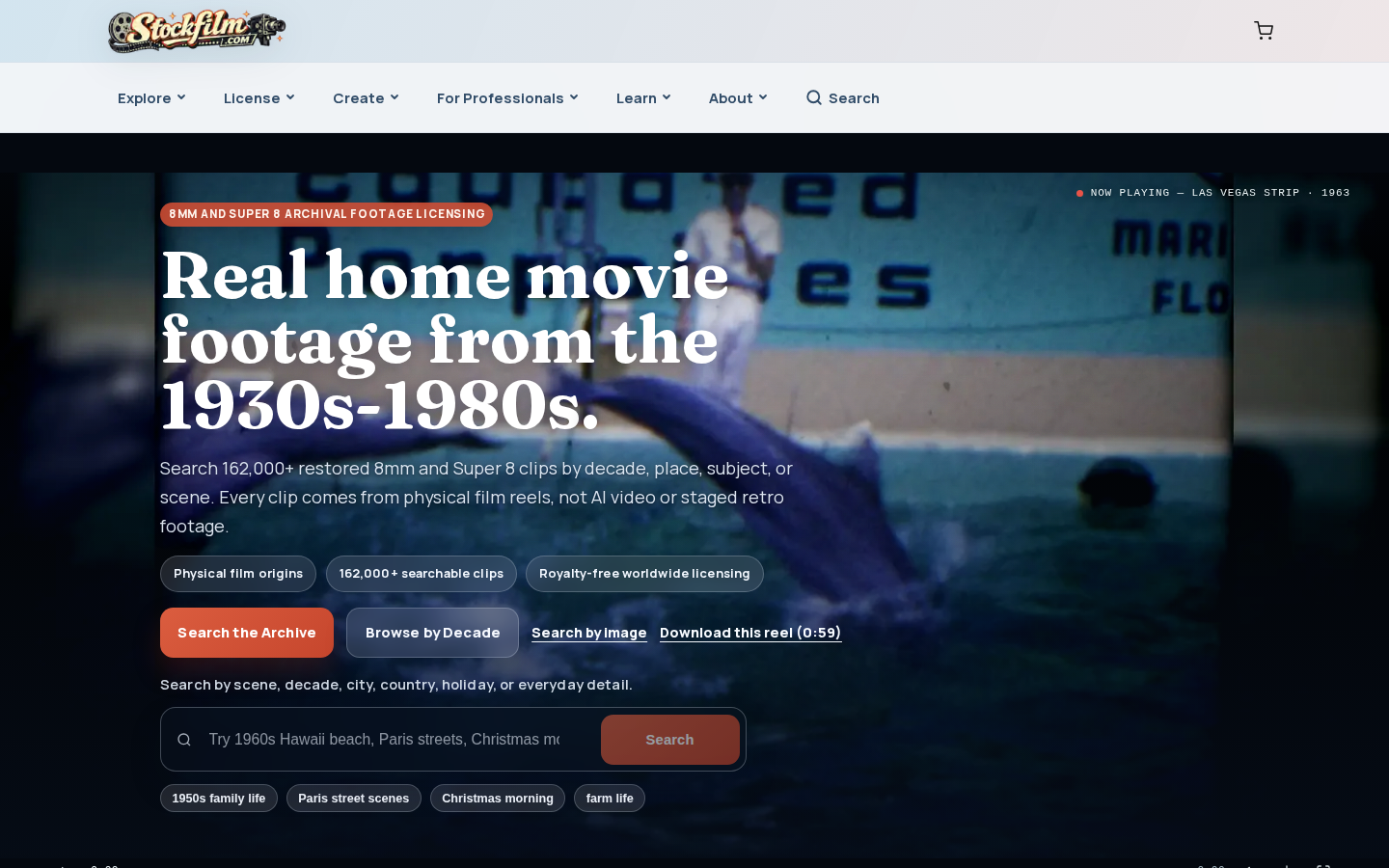
Archive & filmmaker tools
- •Text and image search combines visual embeddings with catalog metadata to find footage by scene, subject, era, and place.
- •AI Clip Analyzer uses custom SigLIP2 classifiers to estimate the decade, subject category, and film damage in uploaded videos and stills.
- •Footage Brief turns a written production brief into a clip shortlist. Project Boards let filmmakers save and organize their selections.
- •Rough Cut Builder assembles archival clips into editable timelines with music, titles, transitions, and rendered MP4 previews.
- •Archive enrichment extracts stills and generates clip context, validates each package, and schedules publication with review flags and rollback support.
Business automation
- •Direct licensing connects checkout, payment confirmation, signed receipts, and secure 4K master downloads for 115,000+ eligible clips.
- •SFAuto monitors production news and footage requests, scores buyer intent, researches leads, and matches projects to relevant catalog clips.
- •Specialist AI agents coordinate scouting, contact research, outreach drafts, and link opportunities through a shared pipeline with approval and escalation rules.
- •Automated publishing researches article topics, finds real archive clips, drafts copy, checks links, and runs an editorial review before publication.
- •Scheduled workers handle enrichment releases, retries, sitemap updates, and health reports; admin tools track search, content, and licensing operations.
Why it matters
Stockfilm shows how AI-assisted development can support an entire working business. Filmmakers can find footage, build a preview, and license a master in one place, while the operator has tools for catalog upkeep, publishing, and sales research. Phil directed the architecture, AI integrations, automation workflows, and production deployment.
Visit Stockfilm.com →Ferrix — High-Frequency Trading Engine
Enterprise-grade Rust trading system designed for high-frequency execution on elite-level colocation servers. Ferrix is a complete integrated stack combining real-time execution with continuous machine learning strategy optimization — built to operate at the latency margins where microseconds determine profitability.
Architecture
- •Event-driven execution engine with actor-based position management
- •Walk-forward validation with holdout testing for ML models
- •Evolutionary parameter optimizer — 70,000+ backtests per second
- •Non-blocking hot-swap of optimized parameters during live trading
- •Tokio async runtime with Rayon parallel processing and SIMD-accelerated parsing
Why it matters
Ferrix demonstrates that AI-assisted development can produce the kind of low-level, performance-critical Rust code that typically requires deep systems engineering expertise. The entire codebase was architected and built using modern LLMs under experienced technical direction.
View on GitHub →ReplayState — Solana Backtesting Engine
A production analytics platform for simulating Solana transaction outcomes against real historical blocks. ReplayState combines deterministic slot replay with Monte Carlo shadow runs to estimate inclusion probability, slippage bands, and MEV exposure before capital is deployed.

Technical challenges
- •Deterministic slot replay against historical archival block state
- •Monte Carlo trial engine (1,000–100,000 runs) with stochastic ordering
- •Outcome distributions for inclusion probability, slippage, and MEV
- •Reproducible seeded runs with signed report manifests
Why it matters
ReplayState turns post-trade guesswork into measurable execution intelligence. Teams can quantify inclusion reliability and adversarial risk before sending transactions to mainnet.
Visit ReplayState.com →TimelineSystem — Legal Timeline Workspace
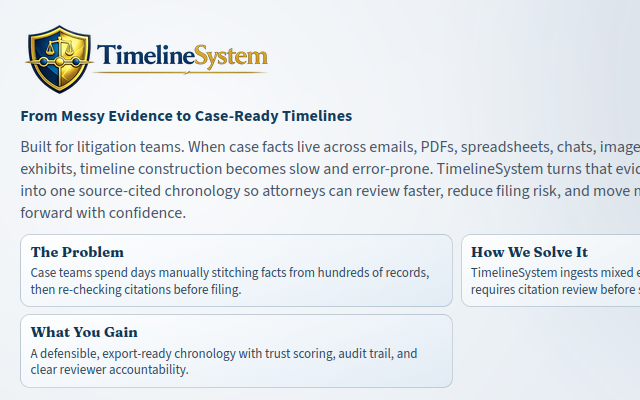
A production workspace for attorneys to review timeline events, evidence, and export-ready case chronologies. TimelineSystem centralizes chronology building, source-document context, and presentation-ready output for litigation teams.
Technical challenges
- •Multi-matter event modeling across filings, evidence, and testimony
- •Fast filtering and chronology search over large document sets
- •Export pipelines for attorney-ready timeline packets
- •Role-based access controls for sensitive legal records
Why it matters
TimelineSystem shows how AI-assisted product development can support demanding legal workflows where chronology accuracy, evidence context, and export quality have real-world impact.
Visit TimelineSystem.com →SettleRisk — Resolution Risk Scoring API
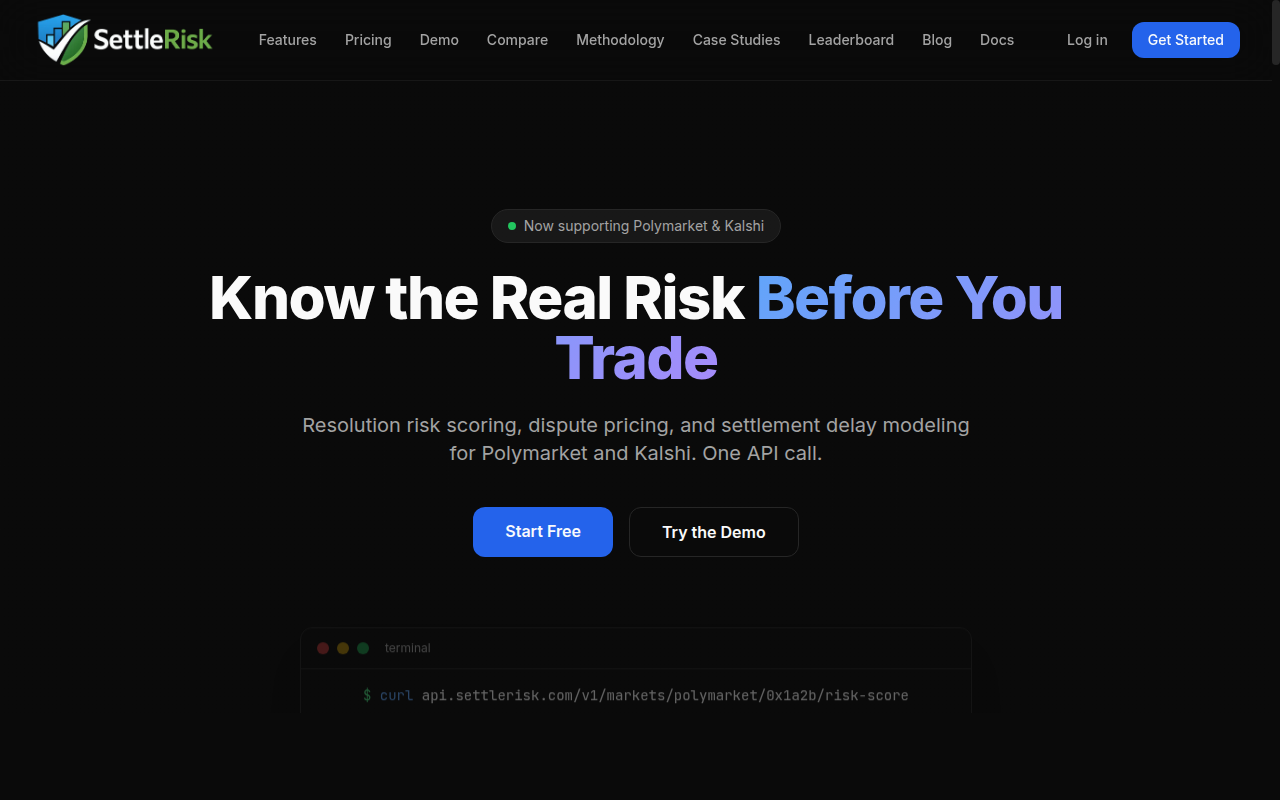
A production SaaS platform providing resolution risk scoring, dispute pricing, and settlement delay modeling for prediction market traders. Built on a Rust backend engineered for sub-200ms response times, serving market makers, prop trading teams, and DeFi protocols at scale.
Technical challenges
- •Rust backend for deterministic, low-latency risk computation
- •REST and gRPC APIs with batch processing (1,000+ markets/call)
- •HMAC-signed webhook delivery across 7 event types
- •Multi-platform calibration (Polymarket + Kalshi)
Why it matters
SettleRisk is a live SaaS product with paying users. Building a scalable Rust API with complex financial modeling and production-grade reliability demonstrates that AI-assisted development works for real commercial software.
Visit SettleRisk.com →LatLongAgo — Geography & History Discovery Game
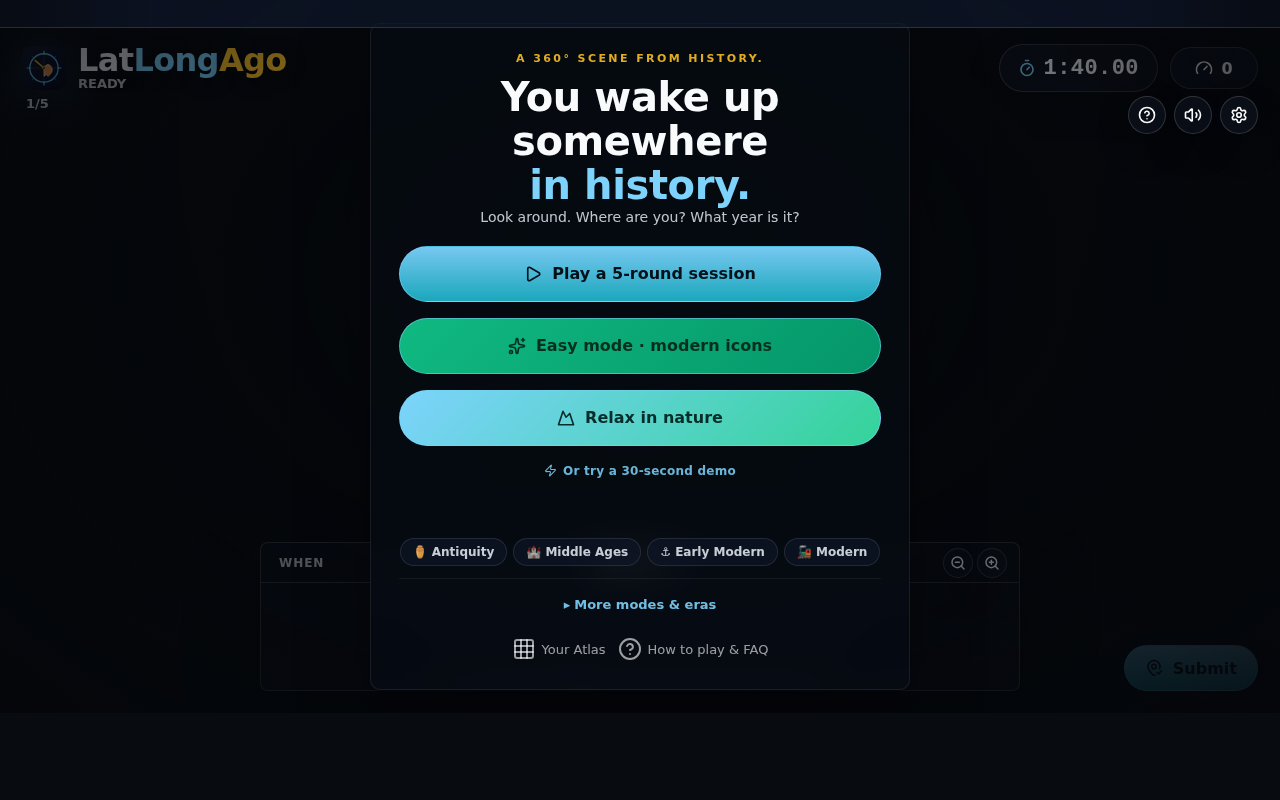
An interactive browser game that drops players into AI-reconstructed 360° panoramas of historical scenes. Players inspect visual, written, and journalistic clues to deduce both the location and the year — a fusion of generative scene synthesis and classic geo-temporal puzzling, drawing from a 336-scene historical archive.
Technical challenges
- •360° panoramic scene rendering with hotspot annotations and context layers
- •Five game modes — Classic, Daily, Duel, Eyewitness, and Newspaper
- •Combined geo + temporal scoring with era-aware tolerance bands
- •Daily-challenge sync, shareable replays, and head-to-head duel codes
- •Streak persistence with local storage and optional leaderboard submission
Why it matters
LatLongAgo shows how AI-assisted development can ship a polished, interactive consumer product end-to-end — combining generative scene design, custom game mechanics, and a content pipeline of 300+ historical reconstructions inside a fully browser-based experience.
Visit LatLongAgo.com →Client Engagements
Business outcomes delivered.
Selected consulting engagements where I helped businesses implement AI systems that reduced manual work, improved operations, and produced measurable results.
Document Processing Automation
The problem
A mid-sized professional services firm processed 200+ documents per week manually — extracting key data, classifying document types, and routing to the right teams. The process consumed ~40 hours of staff time weekly and was error-prone under volume spikes.
The approach
I designed and built an AI-powered document processing pipeline using a combination of OCR, language model extraction, and rule-based routing. The system classifies incoming documents, extracts structured data into their existing tools, and routes items to the appropriate team with confidence scoring.
What changed
- •Document processing time reduced by 75%
- •Manual review limited to edge cases and low-confidence extractions
- •Staff reassigned ~30 hours/week to higher-value work
- •Error rate dropped from ~8% to under 2%
Phil's role
Architecture design, model selection, pipeline development, integration, and team training.
Internal Knowledge Assistant
The problem
A growing consulting firm had 10+ years of project documentation, proposals, deliverables, and internal research spread across shared drives and legacy systems. Finding relevant past work took senior consultants 30–60 minutes per search, and junior staff often couldn't find it at all.
The approach
I built a secure internal RAG-based assistant that indexes their document library and allows natural language search across all historical project materials. The system runs on their infrastructure with no external data exposure, using an open-source language model for privacy compliance.
What changed
- •Average information retrieval time dropped from 30–60 minutes to under 2 minutes
- •Junior staff onboarding time reduced significantly
- •Proposal preparation accelerated by reusing relevant past work
- •Institutional knowledge became accessible instead of locked in senior heads
Phil's role
Requirements gathering, RAG architecture design, open-source model deployment, document pipeline development, and user training.
AI-Assisted Operational Reporting
The problem
A financial services operations team produced weekly and monthly reports by manually pulling data from multiple systems, formatting spreadsheets, writing narrative summaries, and reviewing for accuracy. Each reporting cycle consumed 15–20 hours across the team.
The approach
I built an automated reporting pipeline that pulls data from their existing systems, generates structured reports with AI-written narrative summaries, and flags anomalies for human review. The system drafts complete reports that analysts review and approve rather than create from scratch.
What changed
- •Report generation time reduced from 15–20 hours to 2–3 hours of review
- •Reporting consistency improved across cycles
- •Analysts focused on interpretation and decision-making instead of data assembly
- •Anomaly detection caught issues that manual review had missed
Phil's role
Data pipeline architecture, AI summarization system design, integration development, and workflow redesign.
AI Implementation Roadmap & Advisory
The problem
A mid-market company with ~200 employees wanted to adopt AI across their operations but had no internal AI expertise. They'd received pitches from multiple vendors and agencies but couldn't evaluate the options or determine where to start.
The approach
I conducted a structured AI opportunity audit — mapping their core workflows, identifying automation candidates, evaluating build vs. buy options, and producing a phased implementation roadmap with realistic cost and timeline estimates.
What changed
- •Leadership had a clear, prioritized roadmap instead of vendor confusion
- •Three high-value projects identified and scoped for Phase 1
- •Two low-value vendor proposals correctly declined, saving $150K+ in misdirected spend
- •Internal team aligned on AI strategy and realistic expectations
Phil's role
Operational assessment, opportunity mapping, architecture advisory, vendor evaluation, and roadmap delivery.
Technical depth.
I work across the modern AI stack, choosing the right tools for each problem rather than defaulting to a single approach.
Models & Frameworks
Large language models (GPT-4, Claude, Llama, Mistral), embedding models, fine-tuning pipelines, prompt engineering, and model evaluation.
Architecture Patterns
RAG systems, agent-based workflows, document processing pipelines, classification systems, extraction engines, and multi-model orchestration.
Deployment & Infrastructure
API-based deployments, self-hosted open-source models, hybrid architectures, containerized services, and cloud-native infrastructure.
Integration
REST APIs, webhook systems, database integrations, document management systems, CRM/ERP connectors, and custom middleware.
Data & Privacy
Data pipeline design, PII handling, on-premise deployment for sensitive data, access control architecture, and compliance-aware system design.
Development
Python, TypeScript/JavaScript, Next.js, FastAPI, PostgreSQL, vector databases, and modern web application development.
Have a project in mind?
I'm always interested in hearing about real business problems that AI might help solve. Let's talk.